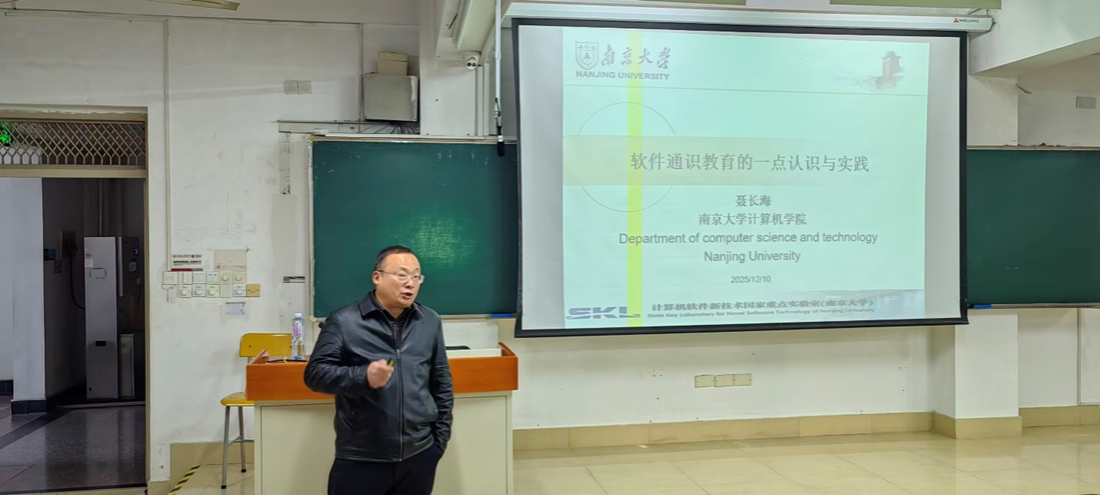
To further strengthen students' software and hardware capabilities and help undergraduates gain an in-depth understanding of systematic knowledge in software ecosystem and software testing, on the morning of December 10, 2025, the Department of Information and Communication invited Professor Nie Changhai from the School of Computer Science of Nanjing University to give a report entitled Some Understandings and Practices of General Education in Software to the undergraduate students of the 2024 grade majoring in Communication Engineering of our university in Classroom 208 of Cuiwu Building, Emerald Lake Campus.
General education in software is a popular software knowledge education for non-computer majors or as a basic enlightenment for computer majors. Its core is to enable learners to master the basic cognition, core logic and application thinking in the software field, rather than training professional software developers. It aims to improve the digital literacy and software application ability of the whole people. Through learning, one can understand the essence, classification and operation logic of software, as well as the connection between software, hardware and network; master the selection and use logic of software tools, and be able to match appropriate software according to actual needs; understand common sense related to software security, data privacy and intellectual property rights, standardize the behavior of using software, and avoid common risks in the digital age.
In this course, combining more than 20 years of teaching and scientific research practice, Professor Nie Changhai focused on the positioning, problems and practical paths of general education in software, providing a systematic idea for the cultivation of cross-field software literacy. He emphasized that the ability of problem abstraction, process-oriented problem-solving thinking, modular and reusable thinking, and data-driven awareness are the software thinking for solving problems. He mainly introduced the development status and trends of knowledge systems in aspects such as software and software engineering, software engineering problems (software system type-related problems (ST), general technical problems (GT), problems of certain characteristics or aspects of software (AA), software engineering problems in the software life cycle process (LC)), the four barriers of software quality (software engineering methods, software testing, fault-tolerant computing, software reliability), blockchain technology and artificial intelligence technology. The report provided a "low threshold, high value, strong practice" implementation paradigm for general education in software, emphasizing that the core is "thinking cultivation" rather than "skill training", which not only breaks the mystery of technology, but also lays a foundation for cross-field innovation. The report was lively and warm. After the report, the students had a face-to-face exchange with Professor Nie Changhai on specific research contents of software combinatorial testing, postgraduate recommendation and admission for master's and doctoral degrees, and career directions after graduation. The report greatly stimulated the students' enthusiasm for learning software classification, composition, compilation and corresponding testing technologies and their scientific research interest.
Lecturer Profile
Nie Changhai, Professor of the School of Computer Science of Nanjing University, Researcher of the State Key Laboratory for Novel Software Technology, PhD supervisor, Distinguished Member of China Computer Federation, and Deputy Secretary-General of Jiangsu Computer Federation. He has taught at Southeast University (1996-2007) and Nanjing University (2008-present) successively, and was a visiting scholar at the Department of Computer Science, King's School London, UK from 2007 to 2008. In more than 20 years of teaching work, he has taught more than 10 mathematics and computer courses for many times, basically covering all the main courses of mathematics and computer science. He has published more than 100 academic papers alone or in cooperation, published the monograph Combinatorial Testing, textbooks Concepts and Methods of Software Testing, Concepts and Methods of Intelligent Software Quality Assurance and Basic Tutorial of Blockchain Technology: Principles, Methods and Practices, and published translated works on the application of new technologies such as artificial intelligence Principles and Applications of Applied Data Analysis and Creating Virtual Prototype Software Projects: Methods and Practices. He has presided over the National 863 Program, sub-projects of the key R&D projects of the Ministry of Science and Technology and a number of National Natural Science Foundation projects, and the projects he participated in have won provincial and ministerial scientific research awards many times as an important member.
 TOP
TOP


