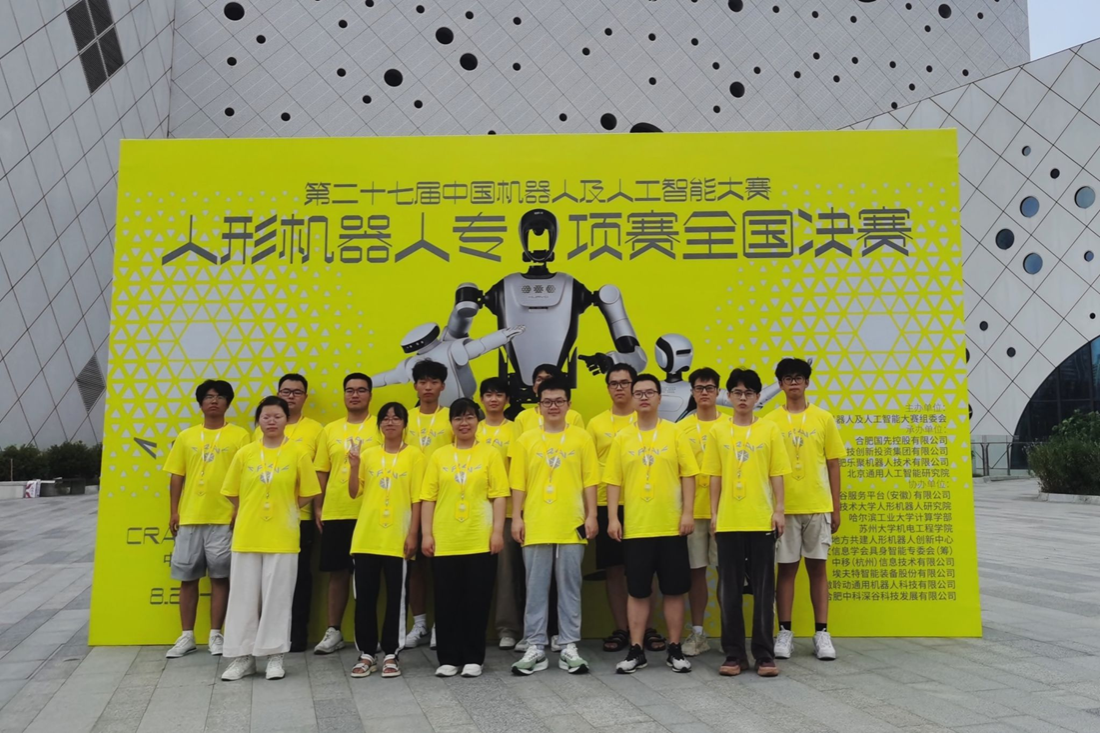
Recently, the national final of the Humanoid Robot Special Competition of the 27th China Robot and Artificial Intelligence Competition was successfully held in Hefei. More than 200 teams from more than 100 universities across the country, including Tsinghua University, Harbin Institute of Technology, Huazhong University of Science and Technology, Xi'an Jiaotong University and Hefei University of Technology, advanced to the national final. After a fierce competition, our university's representative team won 4 first prizes and 4 second prizes in the national final, winning first prizes in all 4 final events it participated in. The level and total number of awards ranked first among the participating universities in the province, setting a historical best result for our university in this competition. Mainstream media such as CCTV, Xinhua News Agency and People's Network have extensively reported on this competition.
Founded in 1999, the China Robot and Artificial Intelligence Competition has gone through 27 sessions of development, attracting a total of more than 1,000 universities and over 460,000 participants across the country. This competition attracted more than 30,000 teams from 900 universities to sign up. Led by innovation, the competition proposed the domestic small humanoid robot competition project for the first time, introduced the large-size humanoid robot innovation challenge at the earliest, and took the lead in adding the full-size humanoid robot event. The competition has been included in the discipline competition ranking of national ordinary schools and universities and the analysis report of school students' competitions of national ordinary schools and universities released by the Chinese Society of Higher Education, and has gradually developed into one of the most influential and comprehensive technical level robot discipline competitions in China. This special competition attracted the active participation of more than 6,000 students from nearly 400 universities across the country. After three rounds of competition: school competition, provincial competition and semi-final, more than 200 teams from more than 100 universities advanced to the national final.
During the competition, our university attached great importance to the organization and training work, and carried out a series of activities such as special training and competition exchange. Relying on the Robot and Intelligent Technology Innovation Base of the School of Computer Science and Information Engineering, we practiced the educational mechanism of "promoting learning through competition, promoting innovation through competition, integrating industry and education, and applying research to practice". The School of Computer Science and Information Engineering attached great importance to this competition. Professor Hong Richang, Dean of the school, visited the training site many times, cared about the progress of preparation and the state of students, carefully inquired about the difficulties encountered in training, and actively coordinated resources to solve them. Vice Deans Li Peipei and Wu Gongqing, together with the participating instructors, encouraged students to firm their confidence, tap their potential and exert their strength, making students deeply feel the care and support of the school and effectively stimulating everyone's fighting spirit.
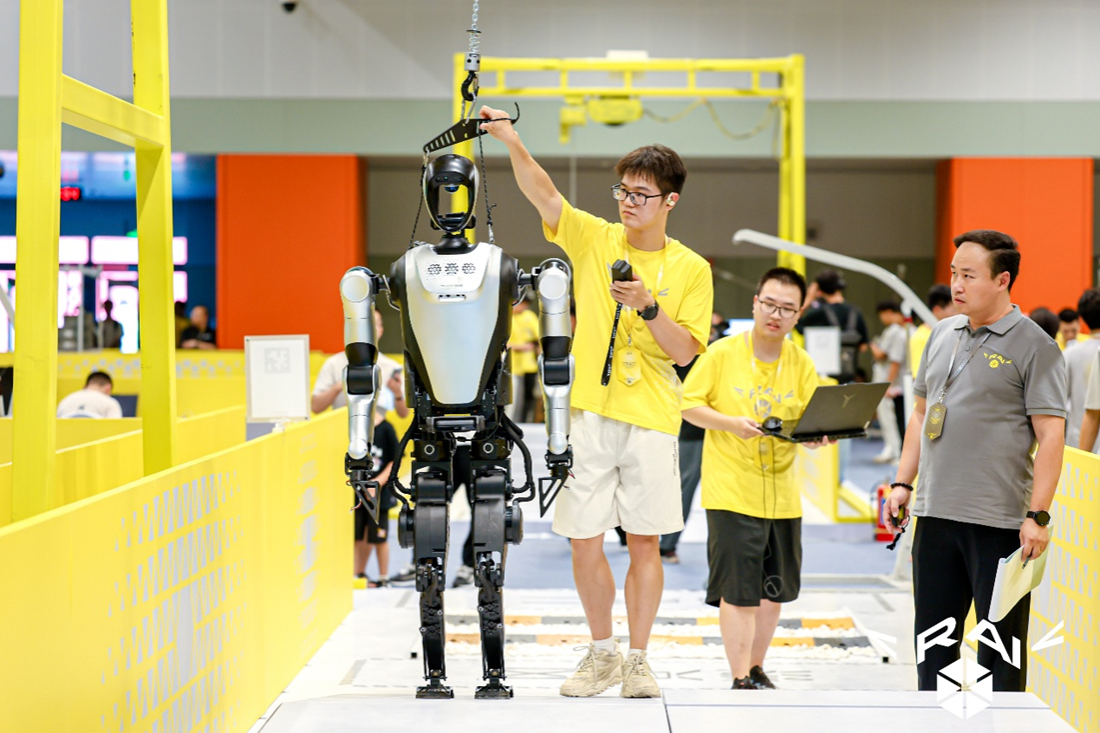
The participating students have long stayed at the competition training base, repeatedly debugging robots and optimizing algorithms, and carrying out systematic training for multiple events such as the Roban Robot Challenge, Aelos Robot Challenge (OpenHarmony version, Raspberry Pi version), and Humanoid Robot Innovation Challenge. Faced with technical difficulties, team members held lively discussions, extensively collected materials, and made unremitting attempts to find various solutions. For example, in the humanoid robot competition, in the face of high-difficulty complex terrain with dense irregular obstacles and continuous random interference, they broke through the traditional control mode and originally proposed the "dynamic segmentation real-time calibration" strategy. By combining online positioning with gait compensation, they achieved high-precision and stable traversal of the robot under strong interference.
The excellent results in this competition fully demonstrate the remarkable achievements of our university in cultivating artificial intelligence talents. Looking forward to the future, the students of our university will continue to forge ahead, create more glories in more competitions, and contribute their youth to the vigorous development of China's artificial intelligence industry.
 TOP
TOP


